Job Introduction - Accommodation Industry
This page provides information to help with career choices, such as the types of jobs available under the accommodation field, annual income by job type, current number of workers, and job descriptions.
Index
- 1. What is the Accommodation Industry under Specified Skilled Worker?
- 1-1 Background
- 1-2 Number of People Working under SSW
- 1-3 Differences Between Technical Intern Training and SSW
- 2. Job description
- 3. Work style and salary
- 3-1 How to read salary and take-home pay
- 3-2 Working hours, work location, and shifts
- 3-3 What to Check in a Job Posting
- 4. Required Exams and Qualifications
- 5. Next Steps
1. What work in this field means
1-1 Background
The accommodation industry is facing difficulty securing workers due to the declining birthrate, diversification of career choices, and other factors, and a serious labor shortage has become clear. As the average age of accommodation workers rises, it has become difficult to secure enough workers using domestic human resources alone. This system was introduced to accept foreign workers in response to this situation.
1-2 Number of People Working under SSW
The Immigration Services Agency compiles and publishes the number of people working under the Specified Skilled Worker status every six months (every 3 months through '22). Based on the data, the population shares by country and age group are as follows.
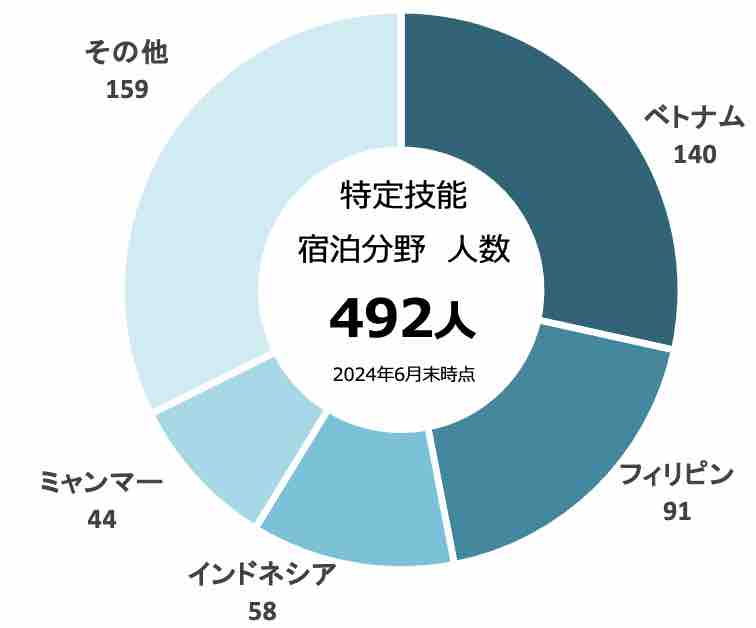
As of the end of June 2024, 492 people work in the accommodation field under Specified Skilled Worker status. By region, most workers are from Asia, with Vietnam, the Philippines, Indonesia, and Myanmar being the top countries of origin.
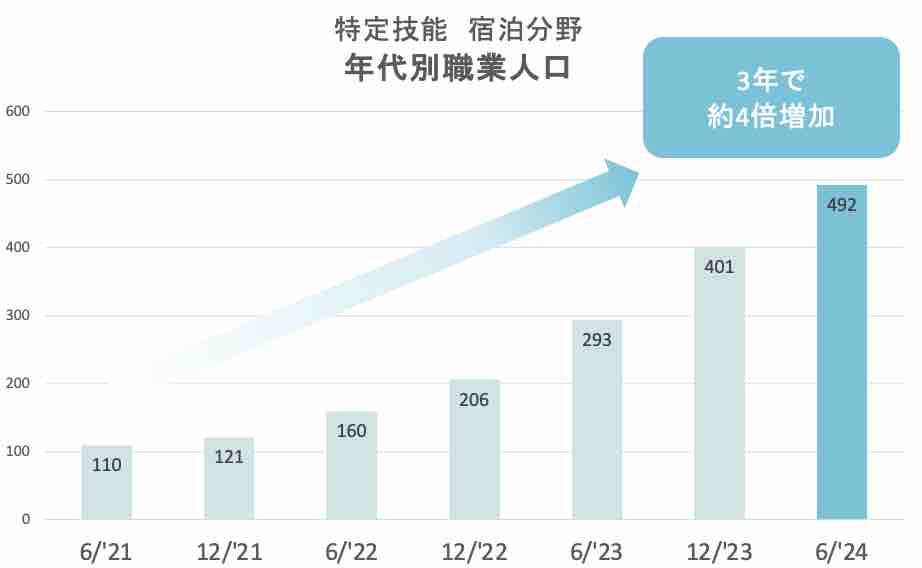
Although the Specified Skilled Worker system began in 2019, the number of people working in the accommodation field under this status has increased by about four times over the past three years, and the number of accepted workers is expected to continue expanding.
source : 出入国在留管理庁(https://www.moj.go.jp/isa/applications/ssw/zairyuarchive.html)
1-3 Differences Between Technical Intern Training and Specified Skilled Worker
There are two systems for accepting foreign workers: the Technical Intern Training Program and the Specified Skilled Worker System, but their purposes and characteristics are very different.
The Technical Intern Training Program aims to help young people from developing countries acquire Japanese technical skills and contribute to the development of their home countries after returning. Its main purpose is skill acquisition, and it is positioned as training rather than labor. Therefore, job changes are not allowed, and the maximum period is five years.
On the other hand, the Specified Skilled Worker System was established to help address Japan's labor shortage. There are Specified Skilled Worker (i) and (ii), and the system accepts foreign workers as job-ready workers. Job changes are possible, and under Specified Skilled Worker (ii), bringing family members and obtaining permanent residency may also be possible. Tests to prove skills and Japanese language ability are required, and people with practical experience may have an advantage.
In addition, foreign nationals who have completed technical intern training can transition to the Specified Skilled Worker System. Experience gained through technical intern training is recognized, and some tests for Specified Skilled Worker (i) may be exempted, making the transition relatively smooth. This allows them to continue working in Japan for a longer period as Specified Skilled Workers after completing technical intern training, expanding opportunities for job changes and career advancement.
2. Job description
2-1 Job Description
The main duties under Specified Skilled Worker “Accommodation” are front desk work, planning and public relations work, customer service work, and restaurant service work.
- Front Desk Work
- Planning and Public Relations Work
- Customer Service Work
- Restaurant Service Work
Checking guests in and out, providing information about nearby tourist attractions, arranging tours departing from or arriving at the hotel, etc.
Planning campaigns and special plans, creating in-house guide flyers, sharing information on websites and social media, etc.
Checking guests in and out, providing information about nearby tourist attractions, arranging tours departing from or arriving at the hotel, etc.
Checking guests in and out, providing information about nearby tourist attractions, arranging tours departing from or arriving at the hotel, etc.
2-2 Differences by work category
In the accommodation industry, the job content changes depending on the assigned area, such as front desk, planning and public relations, customer service, and restaurant service. Front desk work mainly includes check-in, check-out, and answering inquiries. Customer service mainly includes guiding guests inside the facility and helping users. Restaurant service mainly includes serving, clearing tables, and taking orders. Planning and public relations may involve accommodation plans, facility information, and sharing information through social media and websites.
2-3 Knowledge and Japanese needed for work
In the accommodation industry, customer service Japanese is important for guiding guests, confirming reservations, explaining prices, and explaining facility information. Even in cleaning and restaurant support work, you need to understand basic expressions for work instructions, hygiene management, lost items, and complaint handling.
3. Work style and salary
3-1 How to read salary and take-home pay
The average monthly payment for SSW Accommodation workers in 2021 was ¥194,358. This is the average monthly payment based on periodic reports for SSW foreign workers who stayed throughout 2021.
This amount is not take-home pay. Your actual pay varies by taxes, social insurance, dormitory and food costs, overtime and night-shift allowances, region, and company. Check estimated take-home pay, dormitory fees, overtime pay, social insurance, and transportation costs in addition to the monthly salary.
For new fields or fields with few workers, field-specific average payment may not be clear enough in public materials. Check the latest salary terms in the job ad and employment contract.
The salary amounts above are statistical average payments or guide amounts from job conditions. They are not the actual take-home pay. Take-home pay changes depending on taxes, social insurance fees, dormitory fees, food costs, overtime pay, night shift allowance, transportation costs, and other items. Under SSW, the pay must be equal to or higher than the pay of Japanese workers doing the same job.
3-2 Working hours, work location, and shifts
In the accommodation industry, work styles differ depending on the workplace, such as hotels, ryokan inns, and resort facilities. Front desk and restaurant jobs may include early morning, night, weekend, and holiday shifts. The required Japanese level also changes depending on whether the job is mainly cleaning or mainly customer service.
3-3 What to Check in a Job Posting
Before applying, check not only the monthly salary, but also the actual job content, working hours, days off, overtime pay, night shift allowance, dormitory fees, food costs, social insurance, transportation costs, qualification support, who will handle the residence status application, and the name of the registered support organization.
For accommodation jobs, check the actual assigned work, such as front desk, cleaning, or restaurant work, whether there are night shifts, dormitory fees, meal support, uniforms, work location, overtime during busy seasons, and the Japanese level required for customer service.
4. Required Exams and Qualifications
4-1 Tests Required for This Field
To work in Accommodation under SSW Type 1, you must pass a Japanese language test and the Accommodation Field SSW Type 1 Evaluation Test.
To work as Specified Skilled Worker (i), in principle, you need to pass a Japanese language test and a field-specific skills evaluation test. For the Japanese language test, JLPT N4 or higher, or JFT-Basic A2 or higher, is accepted. In the nursing care field, the Nursing Care Japanese Language Evaluation Test is also required. People who have successfully completed Technical Intern Training (ii) may be exempt from tests depending on the field and work content.
4-2 Skills Evaluation Test
The Accommodation Field SSW (i) Evaluation Test checks the knowledge and skills needed to work at accommodation facilities such as hotels and ryokan inns. The test covers front desk work, planning and public relations work, customer service, restaurant service, occupational safety and health, and other basic knowledge. Check the test information page and the official website for detailed test dates, application methods, test format, and sample questions.
5. Next Steps
5-1 Move on to study, job search, and application
After checking the job content and required tests, next check the flow for test study, company search, and residence status application. Even if you pass the tests, you still need an employment contract with a company and a residence status application.