Job Introduction - Fisheries
This page provides information useful for choosing a job, such as job types available in fisheries, annual income by job type, the current number of workers, and job details.
Index
- 1. What is Fisheries under Specified Skilled Worker?
- 1-1 Background
- 1-2 Number of People Working under SSW
- 1-3 Differences Between Technical Intern Training and SSW
- 2. Job description
- 3. Work style and salary
- 3-1 How to read salary and take-home pay
- 3-2 Working hours, work location, and shifts
- 3-3 What to Check in a Job Posting
- 4. Required Exams and Qualifications
- 5. Next Steps
1. What work in this field means
1-1 Background
The fisheries industry is facing difficulty securing workers due to the declining birthrate, diversification of career choices, and other factors, and a serious labor shortage has become clear. As the average age of fisheries workers rises, it has become difficult to secure enough workers through domestic human resources alone. This system was introduced to accept foreign workers in response to this situation.
1-2 Number of People Working under SSW
The Immigration Services Agency compiles and publishes the number of people working under the Specified Skilled Worker status every six months (every 3 months through '22). Based on the data, the population shares by country and age group are as follows.
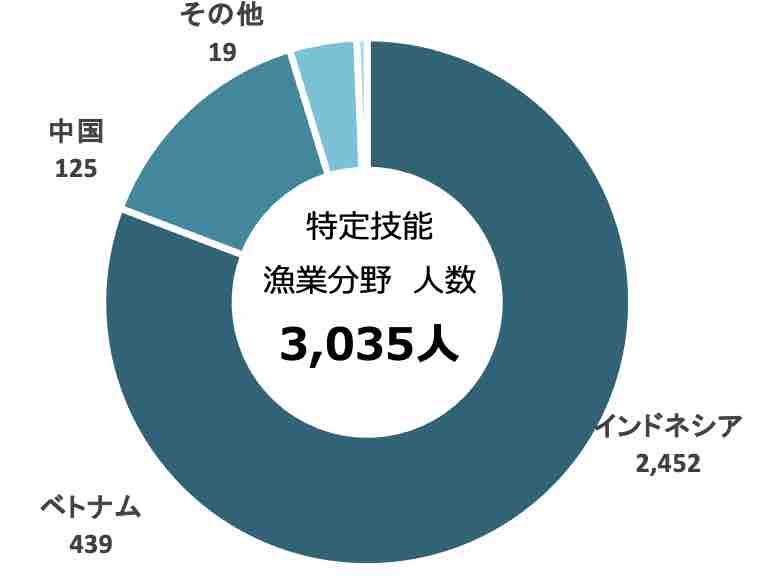
As of the end of June 2024, 3,035 people work in the fisheries field under Specified Skilled Worker status. By region, most workers are from Asia, with Indonesia, Vietnam, and China being the top countries of origin.

Although the Specified Skilled Worker system began in 2019, the number of people working in fisheries under this status has increased by about nine times over the past three years, and the number of accepted workers is expected to continue expanding.
source : 出入国在留管理庁(https://www.moj.go.jp/isa/applications/ssw/zairyuarchive.html)
1-3 Differences Between Technical Intern Training and Specified Skilled Worker
There are two systems for accepting foreign workers: the Technical Intern Training Program and the Specified Skilled Worker System, but their purposes and characteristics are very different.
The Technical Intern Training Program aims to help young people from developing countries acquire Japanese technical skills and contribute to the development of their home countries after returning. Its main purpose is skill acquisition, and it is positioned as training rather than labor. Therefore, job changes are not allowed, and the maximum period is five years.
On the other hand, the Specified Skilled Worker System was established to help address Japan's labor shortage. There are Specified Skilled Worker (i) and (ii), and the system accepts foreign workers as job-ready workers. Job changes are possible, and under Specified Skilled Worker (ii), bringing family members and obtaining permanent residency may also be possible. Tests to prove skills and Japanese language ability are required, and people with practical experience may have an advantage.
In addition, foreign nationals who have completed technical intern training can transition to the Specified Skilled Worker System. Experience gained through technical intern training is recognized, and some tests for Specified Skilled Worker (i) may be exempted, making the transition relatively smooth. This allows them to continue working in Japan for a longer period as Specified Skilled Workers after completing technical intern training, expanding opportunities for job changes and career advancement.
2. Job description
2-1 Job Description
In the fisheries field, there are mainly two job categories: fishing and aquaculture.
Civil Engineering
- Catching fish and shellfish mainly by fishing methods, such as longline fishing, bonito pole-and-line fishing, and squid fishing
- Catching fish and shellfish mainly by methods using nets and cages, such as set net fishing, purse seine fishing, and trawl fishing
- Repairing fishing gear such as nets and cages
- Searching for fish schools using sonar and fish finders
- Operating machines used to haul nets and lines for fishing, such as net and line haulers, and automatic squid fishing machines
- Sorting, boxing, freezing, and preliminary processing of the catch
- Unloading catches, fishing gear, etc. at fishing ports
Aquaculture
- Raising fish, shellfish, algae, etc.
- Feeding farmed fish and removing dead fish, leftover feed, etc.
- Cleaning attached matter from farmed shellfish
- Harvesting farmed aquatic animals and plants and transporting them to fish markets or landing ports
- Shucking farmed shellfish
- Cleaning aquaculture ponds and nets, and managing water quality, etc.
- Constructing and repairing aquaculture rafts
- Producing and collecting seedlings and juvenile stock of farmed aquatic animals and plants, etc.
2-2 Differences by work category
Fishery is divided into catching fish and shellfish, and aquaculture, which raises fish, shellfish, seaweed, and similar products. In fishery, workers prepare fishing gear, search for fish schools, sort catches, pack them in boxes, freeze them, and unload them. In aquaculture, workers feed fish, manage water quality, manage nets and rafts, harvest, and transport products.
2-3 Knowledge and Japanese needed for work
In fishery, Japanese is needed for fishing gear, fish species, weather, marine safety, machine operation, sorting, freezing, unloading, and similar work. In aquaculture, terms related to feeding, water quality, nets, rafts, cleaning, and harvesting are also important.
3. Work style and salary
3-1 How to read salary and take-home pay
The average monthly payment for SSW Fishery workers in 2021 was ¥236,634. This is the average monthly payment based on periodic reports for SSW foreign workers who stayed throughout 2021.
This amount is not take-home pay. Your actual pay varies by taxes, social insurance, dormitory and food costs, overtime and night-shift allowances, region, and company. Check estimated take-home pay, dormitory fees, overtime pay, social insurance, and transportation costs in addition to the monthly salary.
For new fields or fields with few workers, field-specific average payment may not be clear enough in public materials. Check the latest salary terms in the job ad and employment contract.
The salary amounts above are statistical average payments or guide amounts from job conditions. They are not the actual take-home pay. Take-home pay changes depending on taxes, social insurance fees, dormitory fees, food costs, overtime pay, night shift allowance, transportation costs, and other items. Under SSW, the pay must be equal to or higher than the pay of Japanese workers doing the same job.
3-2 Working hours, work location, and shifts
Fishery may include early morning work, schedule changes due to weather, work on boats, and unloading at ports. Aquaculture also often includes outdoor work and work at sea or along the coast. Check seasickness, dormitory, days off, and work location.
3-3 What to Check in a Job Posting
Before applying, check not only the monthly salary, but also the actual job content, working hours, days off, overtime pay, night shift allowance, dormitory fees, food costs, social insurance, transportation costs, qualification support, who will handle the residence status application, and the name of the registered support organization.
For job offers, check whether the job is fishery or aquaculture, whether there is work on boats, early morning work, days off due to weather, dormitory, meals, work clothes and safety equipment, and how to travel to the port or aquaculture site.
4. Required Exams and Qualifications
4-1 Tests Required for This Field
To work in Fishery under SSW Type 1, you must pass a Japanese language test and the Fishery Skills Test.
To work as Specified Skilled Worker (i), in principle, you need to pass a Japanese language test and a field-specific skills evaluation test. For the Japanese language test, JLPT N4 or higher, or JFT-Basic A2 or higher, is accepted. In the nursing care field, the Nursing Care Japanese Language Evaluation Test is also required. People who have successfully completed Technical Intern Training (ii) may be exempt from tests depending on the field and work content.
4-2 Skills Evaluation Test
The Fishery Skills Assessment Test is divided into fishery and aquaculture. The Japan Fisheries Association publishes study texts and sample questions for the Fishery Skills Assessment Test. Check the test information page and the official website for detailed test dates, application methods, and study materials.
5. Next Steps
5-1 Move on to study, job search, and application
After checking the job content and required tests, next check the flow for test study, company search, and residence status application. Even if you pass the tests, you still need an employment contract with a company and a residence status application.